In generative engine optimization (GEO), much of the underlying data—whether for initial planning or ongoing monitoring—comes from automatically submitting prompts to AI platforms and collecting their actual responses.
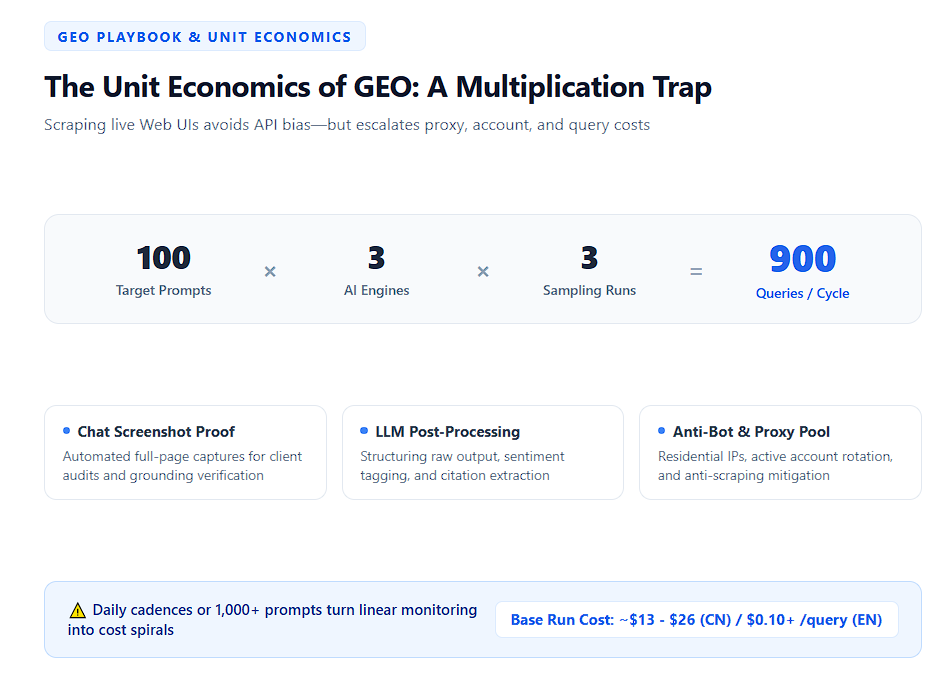
For example, if you track 100 keywords across three AI platforms and submit each query three times on each platform, that adds up to 900 requests.
In theory, APIs would be the most practical way to do this. But there are a couple of issues:
- Can API responses really stand in for responses from the web interface? And would clients accept that? The models and system prompts used in the web interface can be quite different from those available through the API, so the results are very likely to differ as well.
- Some platforms do not expose the full web experience through their APIs. Take DeepSeek, for example: it provides an API for its language models, while its web search functionality relies on other companies’ products. That makes it almost impossible to reproduce its web search experience exactly through the model API alone.
So, to give clients results that reflect the web experience and keep the measurement approach consistent, we end up taking the most direct approach:
That means setting up a pool of accounts, automating interactions with the chat interfaces, and recording the responses, cited sources, any displayed reasoning, and other relevant details in a spreadsheet.
That brings us to another problem: how do you keep the costs under control?
AI chat platforms, regardless of where they operate, have extensive anti-abuse measures to prevent one person from creating large numbers of accounts and submitting requests in bulk.
In China, monitoring responses from AI platforms such as Doubao, DeepSeek, and Qwen may require access to multiple phone numbers to register a pool of accounts.
In the US, monitoring Gemini and ChatGPT often involves email addresses, phone numbers, reliable residential IP addresses, and so on.
The monitoring tools I currently use for Chinese-language AI platforms typically charge RMB 0.10–0.20 per request. For the example at the start of this article, that works out to RMB 90–180 for a single monitoring run.
If you need to run those checks daily, capture screenshots of the conversations at the time of each check, or use AI to further process the response data, those costs add up too.
Of course, you can build your own automation and manage the account pool and scripts yourself. But maintenance is a cost as well.
I do not have firsthand experience with the cost of monitoring English-language AI platforms for GEO. Still, I would not expect it to be particularly cheap. My rough estimate would be USD 0.10–0.20 per request.
If an AI tool lets you submit prompts and receive answers without logging in, however, costs could drop considerably.
These are my observations so far. The GEO monitoring projects I have worked with generally involve fewer than 100 questions per run, so the costs still seem reasonably manageable.
For projects involving thousands of questions, though, finding ways to bring those costs down could become a significant part of the work.
If you have faced similar challenges or have experience to share, I would love to hear from you in the comments.